A foam insert can protect a circuit board from a three-foot drop and still destroy it. Physical cushioning and electrostatic protection are two different jobs, and the standard polyethylene or polyurethane foam that handles the first can actively cause the second by holding and discharging static onto whatever it cradles. If your custom insert will carry printed circuit boards, sensors, drives, or any populated electronics, the foam’s electrical behavior belongs on the spec sheet next to its density and cut method.
When static becomes a case problem
Static damage is usually discussed as a cleanroom or assembly-line concern, but a case is just a small, dry, friction-rich environment on wheels. Every time a part is slid into or out of a foam pocket, the two surfaces rub and separate, and that is precisely how charge is generated. In a shipping case that crosses climates, the humidity can drop low enough to make ordinary foam a genuine hazard rather than a theoretical one. The question is not whether your case generates static — it does — but whether the foam inside it controls that charge or contributes to it.
You need ESD-controlled foam whenever the item touching the foam is static-sensitive and unshielded: bare boards, components on trays, disk drives, RF and microwave parts, and most things with exposed pins or connectors. You can usually skip it when the electronics are fully enclosed in a grounded metal chassis, or when the case holds tools, optics, or mechanical parts with no exposed circuitry. When in doubt, treat a bare board as sensitive.
The three resistance classes
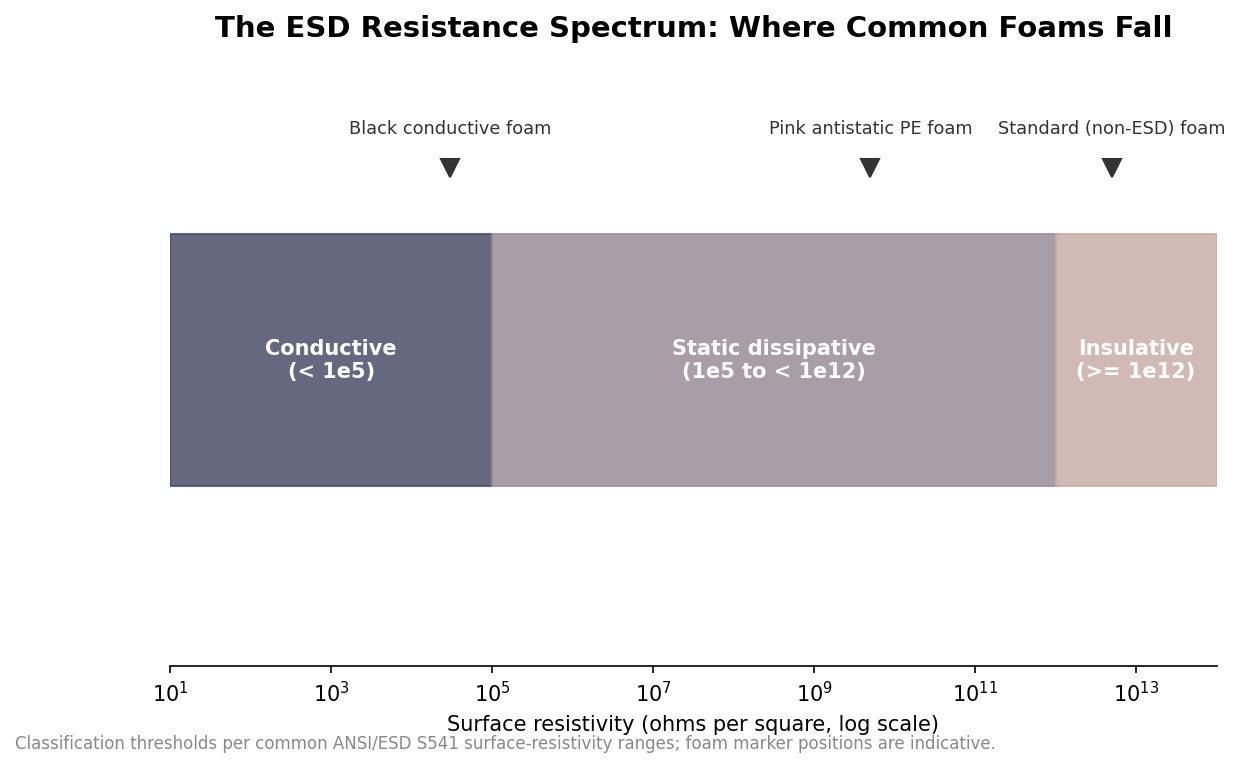
ESD materials are sorted by how readily they let charge move across their surface, measured as surface resistivity in ohms per square. Under the common ANSI/ESD S541 packaging classification, a conductive material sits below about 1 × 10⁵ ohms per square and bleeds charge away fast. A static dissipative material falls between roughly 1 × 10⁵ and 1 × 10¹² ohms per square, letting charge drain in a slower, more controlled way that avoids a sudden spike into the part. An insulative material is at or above about 1 × 10¹² ohms per square; it blocks charge movement, which means it also cannot drain a charge that lands on it. Standard packaging foam is insulative, and that is the problem.
For most electronics cases, dissipative foam is the target. It protects the part two ways at once: it does not itself build a large charge, and if a charged object touches it, it drains that charge gradually rather than dumping it. Conductive foam drains faster still and is common for shorting component leads, but its speed is not always desirable for finished assemblies. The chart below shows where the classes divide and where common foams land on the scale.
“Antistatic” is not a magic word
The most misused term in this whole discussion is antistatic. Strictly, antistatic describes a material that resists generating a charge in the first place through friction — low tribocharging — which is a different property from where it sits on the resistance scale. The familiar pink foam and pink poly bags are antistatic in that sense: they are treated so they do not readily build a charge, and many also fall in the dissipative range. But “antistatic” on a listing does not guarantee a specific surface resistance, and a pink foam that has aged or been wiped can lose its treatment. If protection matters, specify the resistance class and a target resistivity, not just the word or the color.
Color is a useful shorthand, not a standard. In common practice black often signals conductive foam, pink signals antistatic or dissipative foam, and plain white or blue foam is usually ordinary insulative material with no static control at all. Those conventions vary by supplier, so treat color as a first clue and confirm the actual electrical spec before you commit a run.
How much static are we actually talking about?
The reason this matters is the mismatch between what handling generates and what parts can survive. According to ESD Association fundamentals, simply walking across a carpet can put a person at around 35,000 volts in dry conditions, and picking a poly bag up off a bench can reach 20,000 volts. Raise the humidity and those numbers fall dramatically — carpet drops to about 1,500 volts, a worker at a bench to roughly 100 — but you cannot count on humidity inside a sealed case in winter transit. Meanwhile many components are damaged below 100 volts, and some drive components below 10. The gap between generation and tolerance is enormous, and dissipative foam exists to close it.

Two things stand out in those figures. First, low humidity is the danger zone, which is exactly the condition a case can create when it moves from a warm truck into a cold, dry warehouse. Second, the damaging threshold sits far below the everyday voltages, so “I didn’t feel a shock” is meaningless — you cannot feel a discharge until it is in the thousands of volts, long after it would have killed a sensitive part.
Specifying ESD foam for a custom insert
Put the electrical requirement in writing alongside the mechanical one. Name the class you need — usually static dissipative — and, if your quality process requires it, a target surface-resistivity window and the test method. State the foam type and density separately, since a dissipative additive can be carried in different base foams with different firmness and cut behavior. Ask whether the ESD property is a bulk characteristic of the foam or a surface treatment, because treatments can wear or wipe off over time and repeated use. And remember that ESD foam only does its job as part of a grounded system: the foam controls charge, but the case, the handling, and the people all sit in the same static circuit.
The practical rule is simple. If the foam will ever touch bare, powered, or unshielded electronics, specify a dissipative or conductive material by its resistance class, not by color or by the word antistatic, and verify it the same way you would verify a critical dimension. The cushioning keeps the part from breaking; the ESD spec keeps it from dying quietly on the bench weeks later.
Leave a Reply