Custom foam inserts give aviation maintenance teams a visual tool control system: every tool sits in its own cut pocket, so a missing item shows before a panel is closed or a technician leaves the aircraft. Customized Foam Inserts cuts drawer inserts, line kit cases and shadow boards from your tool list, with a free mockup within 24 hours.
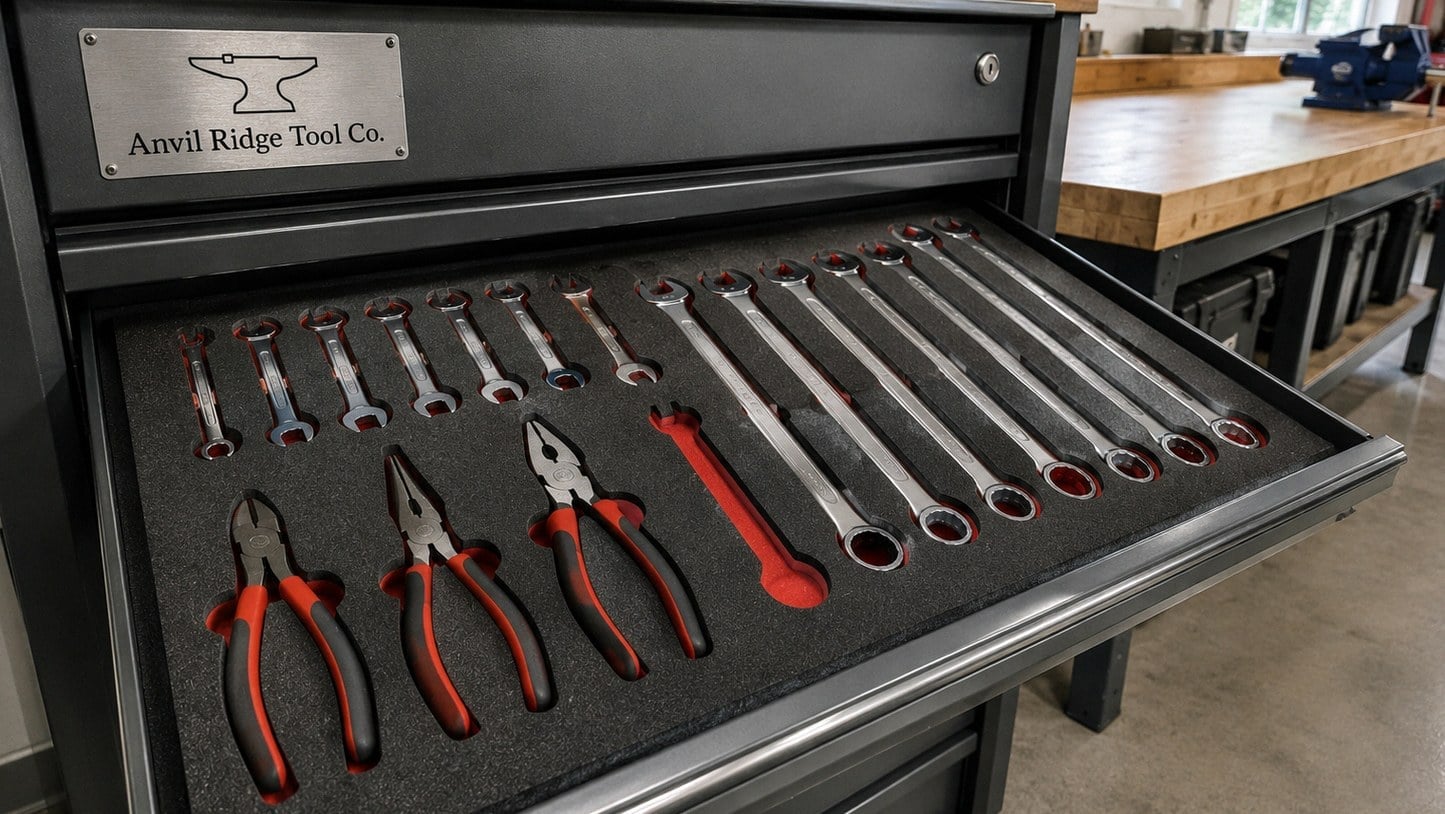
- Every tool gets its own cut pocket, so a missing item shows at a glance.
- Two-tone foam makes empty pockets stand out under hangar lighting.
- Etched labels can carry tool numbers, kit IDs or technician names.
- Free mockup within 24 hours, with unlimited free revisions.
- Orders start at 12 foam inserts, with standard turnaround of about 2 weeks.
Why do aviation maintenance teams use custom foam inserts for tool control?
Aviation maintenance teams use custom foam inserts because a cut pocket for every tool turns tool control into a glance. When a technician closes a panel or signs off a task, an empty pocket shows at once that a wrench, driver or inspection mirror is still somewhere on the aircraft, in an intake or behind an access door.
Loose tools in a drawer or a soft bag cannot do that. A missing item blends in with everything else, and finding the gap means counting against a list. A foam insert cut to the exact outline of each tool makes the inventory visual, so the check takes seconds and does not depend on memory at the end of a long shift.
Customized Foam Inserts cuts each insert from your own tool list and case or drawer model, so the layout matches what your technicians actually carry rather than a generic kit. Common builds for hangar work include:
- Rolling tool chest drawers organized by task or by tool type.
- Hard cases for line maintenance kits that travel to the ramp or a remote stand.
- Shadow boards for shared crib tools and specialty fixtures.
- Lid inserts for flat items such as feeler gauges and torque charts.
How should a hangar lay out foam inserts for tool chest drawers?
A hangar should lay out tool chest foam inserts so that each drawer serves a clear purpose and every pocket has visible space around it. The best layouts group tools by how they are used on the job, keep frequently used items toward the front of the drawer, and leave a finger pull beside each tool so gloved hands can lift it out cleanly.
Start with an honest list of what lives in each drawer today, then remove anything that belongs elsewhere. Drawer depth matters: shallow drawers suit a single layer with sockets, wrenches and pliers laid flat, while deeper drawers can hold ratchets, torque wrenches and inspection lights with stepped pockets.
A practical drawer plan for an aviation tool chest often looks like this:
- Top drawers: screwdrivers, picks, mirrors and small inspection tools used on nearly every task.
- Middle drawers: sockets, extensions and ratchets grouped by drive size.
- Lower drawers: pliers, safety wire tools, cutters and larger wrenches.
- Bottom drawer: torque wrenches and bulky items in deeper pockets.
The tool drawer foam organizer page shows the drawer builds Customized Foam Inserts produces, and the free mockup lets your lead technician confirm the arrangement before anything is cut.
Should aviation foam inserts be two-tone or single-color?
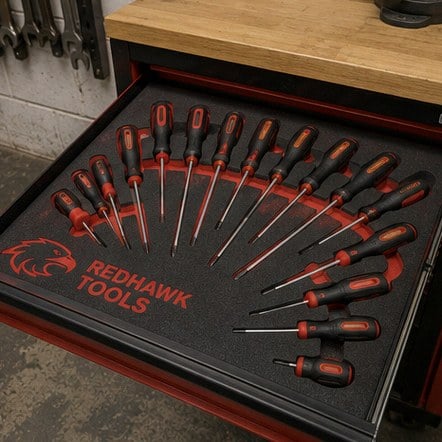
Most aviation tool control programs choose two-tone foam inserts, because a contrasting bottom layer makes an empty pocket stand out sharply under hangar lighting. A bright base under a dark top layer means a missing tool shows as a bold patch of color that a supervisor can spot from across the bay.
Single-color foam inserts still work well when the case is used for shipping parts, holding test equipment, or storing items that are checked by a separate process. The outline of each pocket still marks where an item belongs, and a single color can suit cases that sit in a stores area rather than on a tool chest.
The decision usually comes down to how the insert will be inspected:
| Use in the hangar | Usual choice | Reason |
|---|---|---|
| Technician tool chest drawers | Two-tone | Empty pockets are obvious at shift change |
| Line maintenance kits | Two-tone | Fast visual check before leaving the aircraft |
| Test equipment cases | Single-color or two-tone | Fewer items, often logged separately |
| Parts shipping cases | Single-color | Protection matters more than visual inventory |
For a full side-by-side, see two-tone vs single-color foam inserts.
Can foam inserts carry tool numbers, crib IDs or technician names?
Foam inserts can carry etched labels beside each pocket, which aviation teams use for tool numbers, crib identifiers, kit names or the name of the technician who owns the chest. Labels turn the insert into a reference that matches your tool control records, so anyone checking a drawer knows exactly what belongs in each space.
Labeling is especially useful when several tools look alike. Two sockets that differ by one size, or a pair of similar safety wire pliers, are easy to swap by mistake. A label under each pocket removes the guesswork and makes the correct return location obvious.
Within one order, Customized Foam Inserts can vary the labels from insert to insert while keeping the pocket layout identical. That lets a maintenance organization give every technician the same drawer layout with a different name or chest number on each set, which keeps training simple and still ties each insert to one person or one station.
Send your naming convention with your tool list, and the mockup will show each label in place for review.
How do line maintenance kits differ from hangar tool chests?
Line maintenance kits differ from hangar tool chests because they travel. A kit carried to the ramp, a remote gate or another station needs a hard case with a foam insert that holds every tool firmly, survives being carried and loaded into vehicles, and can be checked quickly before a technician walks away from the aircraft.
That changes the design priorities. Pockets should hold tools snugly so nothing shifts in transit, and the most important items should be visible as soon as the lid opens. A lid insert can secure flat items and keep everything pressed in place when the case is carried on its side.
Good line kit foam inserts usually share these traits:
- A fixed, minimal tool list built around the tasks the kit supports.
- Two-tone foam so a missing tool shows before the case is closed.
- Labels with the kit identifier, so each case can be logged in and out.
- Room for a flashlight and inspection mirror, which are easy to leave behind.
Customized Foam Inserts cuts these kits for the hard case your team already uses. See the hard case foam insert and equipment case foam pages for case builds.
Where do shadow boards fit in an aviation tool control program?
Shadow boards fit in an aviation tool control program wherever tools are shared rather than assigned to one technician. A tool crib, a specialty fixture wall or a shared bench benefits from a foam shadow board because every item has a marked home that anyone can check, and an empty outline immediately shows what has been signed out.
Foam shadow boards work well for bulky or awkward items that do not fit in a drawer: rigging fixtures, special adapters, borescope accessories and long extensions. A board mounted near the work area keeps those items visible instead of buried in a cabinet.
Many organizations pair shadow boards with a sign-out log, so the empty pocket shows that something is out and the log shows who has it. Customized Foam Inserts produces custom shadow boards in the same foam and color options as drawer inserts, so the crib and the tool chests share one visual system. That consistency helps new technicians learn the program faster.
What do you need to send to get aviation foam inserts quoted?
To get aviation foam inserts quoted, send the make and model of each tool chest or case, a list of the tools for each drawer or kit, and a note on whether you want two-tone foam and etched labels. With that information Customized Foam Inserts can prepare a free mockup within 24 hours, with unlimited free revisions until the layout is right.
Photos help. A picture of each drawer with the tools laid out the way your technicians prefer them gives the layout team a strong starting point. Note any tools that are oversized, unusually shaped or still to be purchased, so space can be planned for them.
Orders start at 12 foam inserts, which suits most hangars once drawers across several chests are counted together. Standard turnaround is about 2 weeks after you approve the mockup, with faster turnaround available with express shipping. You pay nothing until you approve the design. Request yours through the custom quote form, or read how it works first.
How do you keep foam inserts consistent as the fleet and tool list change?
Foam inserts stay consistent across a growing maintenance operation when the approved layout is treated as a controlled standard. Customized Foam Inserts keeps your approved layout files on record, so a new technician’s chest, a replacement drawer or an extra line kit can be reordered to match the originals exactly.
Tool lists do change. A new aircraft type, a revised task card or a replacement tool with a different outline may mean an updated layout. When that happens, request a revised mockup for only the affected drawers, approve it, and roll it out across the chests that need it. Unchanged drawers stay as they are.
A few habits keep the program tidy over time:
- Assign one person to approve layout changes so drawers do not drift.
- Order a small set of spare inserts for drawers that see the heaviest wear.
- Replace worn inserts before pockets lose their grip on tools.
This keeps every insert in the hangar telling the same story at a glance.
Frequently asked questions
Can custom foam inserts be cut for torque wrenches of different lengths?
Custom foam inserts can be cut for torque wrenches of any length your chest or case can hold. Customized Foam Inserts lays each wrench out in its own deep pocket, often in a bottom drawer, with a finger pull at the handle. Send the make and model of each wrench so the mockup shows a snug outline that keeps it from sliding when the drawer opens.
Do foam inserts help technicians spot a missing tool before closing an access panel?
Foam inserts help technicians spot a missing tool because every item has its own cut outline. An empty pocket shows immediately, especially in a two-tone build with a contrasting base layer. That quick visual check before closing a panel or leaving the aircraft is the main reason maintenance teams adopt foam tool control in drawers and line kits.
Can one order cover tool chests from different manufacturers?
One order of foam inserts can cover tool chests from different manufacturers, as long as you list each chest make and model. Customized Foam Inserts sizes every insert to its own drawer, so a mixed fleet of chests can still share a consistent pocket arrangement and color scheme. The mockup shows each chest separately for approval.
Should safety wire and consumables have pockets in a foam insert?
Foam inserts can include pockets for safety wire spools, cotter pin boxes and similar consumables, but many hangars keep consumables in a separate drawer. Mixing tools and consumables in one insert can blur the visual check. Customized Foam Inserts can cut a dedicated consumables drawer so tool drawers stay clean and easy to inspect.
How do foam inserts work with tools that are checked out from a crib?
Foam inserts work with crib checkout by giving every shared tool a labeled home. When a tool leaves the crib, its pocket stays empty until it returns, and the label shows exactly which item is out. Many teams pair the insert with a sign-out log so the empty pocket and the log entry confirm each other.
Can foam inserts hold inspection mirrors and flashlights securely?
Foam inserts can hold inspection mirrors and flashlights in pockets cut to their exact outline, which keeps the glass and lens protected. These small items are among the easiest to leave behind on a job, so Customized Foam Inserts recommends placing them near the front of the drawer or kit where an empty pocket is noticed first.
What foam color combinations do maintenance teams often choose?
Maintenance teams ordering foam inserts often choose a dark top layer over a bright base, such as black over red or black over yellow, because the contrast makes empty pockets obvious. Some organizations match the base color to a department or station. Customized Foam Inserts shows the chosen colors on the free mockup so you can compare options.
Can a foam insert layout be standardized across several hangars or stations?
A foam insert layout can be standardized across several hangars or stations by approving one master layout per drawer or kit and reordering from it. Customized Foam Inserts keeps approved layouts on file, so every location receives identical inserts. Labels can still vary by station so each set ties back to its own location.
Are foam inserts suitable for specialty tooling such as rigging fixtures?
Foam inserts suit specialty tooling such as rigging fixtures, adapters and borescope accessories, either in a deep case or on a foam shadow board. Customized Foam Inserts needs a photo and the outline or model of each fixture to cut accurate pockets. Larger items often fit best on a wall-mounted board near the work area.
How should worn foam inserts be replaced in a busy hangar?
Worn foam inserts in a busy hangar should be replaced drawer by drawer from the approved layout on file, so the new insert matches the old pocket arrangement exactly. Keeping a few spare inserts for the most used drawers reduces downtime. Customized Foam Inserts can reorder single drawers once the order minimum of 12 is met across the request.
Can apprentices and new technicians use the same foam insert layout as senior staff?
Apprentices and new technicians can use the same foam insert layout as senior staff, which shortens training because every chest looks alike. Customized Foam Inserts can keep the pockets identical and vary only the etched names or chest numbers. A shared layout also makes it easier for supervisors to inspect any drawer in the hangar.
Get a free mockup for your foam inserts
Send your logo or idea and the quantity you have in mind. Customized Foam Inserts returns a free mockup within 24 hours, you approve the design before anything is produced, and standard turnaround is about two weeks with faster options available. Get a custom quote.