Single-layer foam inserts are the right build for shallow drawers and cases where every item sits at one level, while multi-layer foam inserts make sense for deep cases, small parts that hide under larger tools, and kits that need a lift-out tray. Customized Foam Inserts cuts both builds from your item list and shows the layer plan on a free mockup within 24 hours.
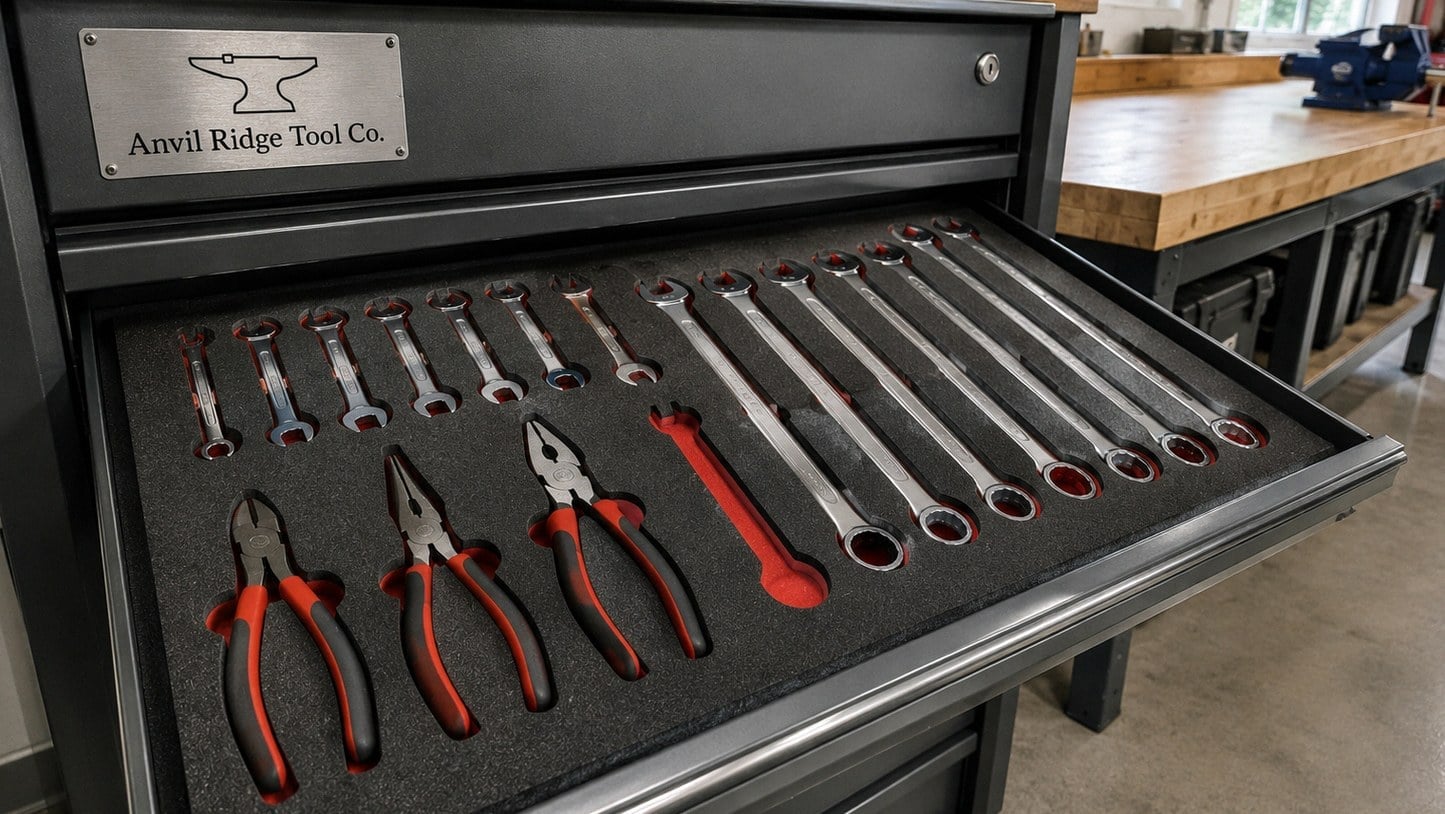
- Single-layer foam inserts suit shallow cases, tool drawers and shadow boards.
- Multi-layer foam inserts stack separate sheets or step pocket depths for deep cases.
- A lift-out top layer can turn one deep case into a two-level kit.
- Every layer plan appears on a free mockup within 24 hours, with unlimited free revisions.
- Orders start at 12 foam inserts with standard turnaround of about 2 weeks.
What is the difference between a single-layer and a multi-layer foam insert?
A single-layer foam insert is one sheet of foam with pockets cut to hold every item at the same level, so you see the whole kit the moment the lid opens. A multi-layer foam insert uses more than one sheet, or several pocket depths in one block, so items can sit at different heights or stack one level above another.
Both builds start the same way: Customized Foam Inserts takes your case model and item list, lays out the pockets and sends a free mockup within 24 hours. The difference is how the depth of the case gets used. A single layer spends the full depth on one row of tools. A layered build divides that depth so a tall item can drop to the floor of the case while flat or small items rest on a shelf above or in a tray that lifts out.
There is also a middle option. A single block of foam can be cut with stepped pockets, where a socket rail sits shallow and a drill body sinks deep, all in one piece. That gives you multi-depth storage without separate sheets to lift.
When is a single-layer foam insert the better choice?
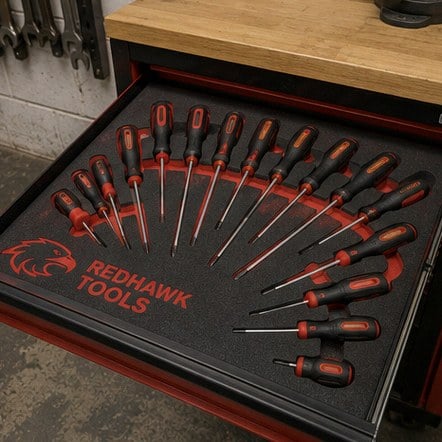
A single-layer foam insert is the better choice when your case or drawer is shallow, when every item needs to be visible at a glance, and when the kit is checked in and out many times a day. Tool control depends on seeing an empty pocket instantly, and a single layer never hides a missing tool under another one.
Single-layer builds are the natural fit for:
- Tool drawers. Roll cab and toolbox drawers are rarely deep enough for stacking, and a tool drawer foam organizer works best when the whole drawer reads as one shadow outline.
- Shadow boards. Wall and bench boards are single-layer by nature, since every tool hangs in view.
- Presentation boxes. A product or gift set shown to a customer should open on one clean level, which is why presentation box foam is usually a single sheet.
- Flat kits. Calipers, gauges, hand tools and test leads lie flat and gain little from a second layer.
A single layer is also simpler to approve. You check one layout on the mockup, confirm each pocket and move on.
When does a multi-layer foam insert make more sense?
A multi-layer foam insert makes more sense when the case is deep, the kit mixes tall and flat items, or small parts would otherwise rattle loose in leftover space. Deep hard cases are the clearest example: a single sheet spends the full depth on a row of pockets, and the space above shorter items goes to waste.
Layered builds are the usual answer for:
- Deep hard cases. A hard case foam insert can hold a large meter or power tool on the bottom layer with leads, batteries and adapters in a tray above.
- Equipment kits with accessories. Field instruments often travel with cables, chargers and manuals. Equipment case foam with a lift-out layer keeps accessories off the main device.
- Demo and sample kits. A top layer can present the product while the setup gear waits underneath, a common build for trade show and product demo kits.
- Shared kits. When one person uses the top tray daily and the bottom layer only for service jobs, layering separates everyday items from occasional ones.
The trade-off is visibility. Anything on a lower layer is out of sight until the top layer comes out, so plan layers around how often each item is used.
Single-layer vs multi-layer foam inserts at a glance
The table below compares the two builds on the points buyers ask about most. Use it as a starting point, then confirm the choice on your mockup from Customized Foam Inserts.
| Factor | Single-layer foam insert | Multi-layer foam insert |
|---|---|---|
| Best case type | Shallow cases, drawers, boards | Deep hard cases and equipment cases |
| Visibility | Every item in view | Lower layer hidden until the tray lifts |
| Small parts | Need their own pockets on the same level | Can sit in a tray above larger items |
| Tool control | Fastest empty-pocket check | Check each layer separately |
| Mockup review | One layout to approve | One layout per layer to approve |
| Changing the kit later | Recut one sheet | Recut only the layer that changed |
Neither build is more durable by default. Durability comes from the foam type and the fit of each pocket, both of which are covered in the material comparison and on the mockup itself.
How do stepped pockets compare to separate stacked layers?
Stepped pockets and stacked layers both use the depth of a case, but stepped pockets do it in one piece of foam while stacked layers use separate sheets that come apart. Stepped pockets suit kits where everything should still be visible from above. Stacked layers suit kits where you want a second level hidden under a tray.
With stepped pockets, a CNC router cuts each pocket to the depth its item needs. A tall tool sinks deep, a flat gauge sits shallow, and a finger notch beside each item lets you lift it out. You still see every item from above, so stepped pockets keep the tool-control advantage of a single layer while using more of the case depth.
With stacked layers, the top sheet is its own insert. You lift it out, often by a finger pull or a cut-in handle slot, and the layer below holds the heavier or less-used items. Each layer can be reordered or recut on its own, which is useful when only the accessories change.
A quick rule
If people need to see every item before they leave the bay, choose stepped pockets. If the case holds a main device plus a separate set of accessories, choose stacked layers.
What should you send so Customized Foam Inserts can recommend a build?
Send the case make and model, the full item list and photos of the items laid out the way you use them, and Customized Foam Inserts will recommend a single-layer, stepped or stacked build on the mockup. You do not need to decide the build before you ask for a quote.
- Name the case. The make and model tells the cutting team the interior depth and shape, including any lid space.
- List every item. Include small parts such as bits, batteries, cards and adapters, since these often decide whether a second layer is worth it.
- Mark how often each item is used. Daily items belong on the top layer or in a single-layer build. Occasional items can drop to a lower layer.
- Say who opens the case. A shared fleet kit may favor single-layer visibility, while a personal service kit can use a tray.
- Request a quote. The custom quote form takes your details, and a free mockup arrives within 24 hours.
You pay nothing until you approve the design, and revisions are unlimited and free, so switching from one build to another at mockup stage costs you only a reply.
Which build should a first-time buyer choose?
A first-time buyer should usually start with a single-layer foam insert or stepped pockets unless the case is clearly deep enough to waste space. Those builds are easier to check, easier to train people on and quicker to approve, and the layout can move to stacked layers on a reorder once the kit has been used in the field.
Choose a multi-layer foam insert from the start when one of these is true: the case holds a large main device plus loose accessories, small parts are already getting lost in the bottom of the case, or the kit has a presentation side and a working side. In those cases a tray pays for itself in time saved digging for parts.
Whatever you pick, Customized Foam Inserts keeps your approved layout on file, so a pilot order of 12 can be reordered as-is or adjusted layer by layer. Standard turnaround is about 2 weeks, with faster turnaround available through express shipping. To see how the order flows from item list to finished foam, read how it works, or browse the full range of custom foam inserts.
Frequently asked questions
How do I know whether my case is deep enough to need a layered foam insert?
A layered foam insert is worth considering when your tallest item still leaves a band of empty depth above the shorter items. If small parts or accessories could sit in that band, a second layer will use it. Send your case model and item list to Customized Foam Inserts and the mockup will show whether a single layer, stepped pockets or stacked layers fits best.
Can the top layer of a foam insert lift out as a removable tray?
Yes, a foam insert can be built with a top layer that lifts out as its own tray. The tray is usually cut with a finger pull or handle slot so you can grab it without tipping items. Underneath, the bottom layer holds heavier or less-used gear. Each tray is drawn on the mockup so you can check the reach and the pocket placement.
Are single-layer foam inserts easier to keep tidy on a busy job site?
Single-layer foam inserts are generally easier to keep tidy because every item has one visible pocket and nothing stacks on top of anything else. Crews can spot a missing tool at a glance and wipe dust or debris off one surface. For kits that are opened many times a shift, Customized Foam Inserts often recommends a single layer for that reason.
Can small parts be stored underneath larger tools in a stacked foam insert?
A stacked foam insert can store small parts on a lower layer beneath larger tools, but most buyers do the opposite. Small parts are easier to find on a top tray, while the large main tool sits deep in the bottom layer. The mockup lets you test both arrangements and choose the one that matches how your team actually unpacks the case.
What is a finger pull and why do layered foam inserts often include one?
A finger pull on a foam insert is a small cutout beside a pocket or along the edge of a tray that gives your fingers room to grip. Layered builds rely on finger pulls so a top layer can be lifted without prying, and so snug items come out cleanly. Customized Foam Inserts places them on the mockup where your hand naturally reaches.
Should a foam insert for a toolbox drawer be single-layer or layered?
A foam insert for a toolbox drawer is almost always single-layer, because most drawers are shallow and tool control depends on seeing every outline when the drawer opens. Stepped pockets can still give deeper tools such as ratchets or pliers a better grip. Stacked layers are rarely practical in a drawer, since lifting a tray inside a cabinet is awkward.
Can I switch from a single-layer to a multi-layer foam insert on a reorder?
Yes, a foam insert design can move from a single layer to a layered build on a reorder. Customized Foam Inserts keeps your approved layout on file, so the existing pockets become the starting point and a new mockup shows how the items would split across layers. You approve the revised design before anything is cut, and nothing is charged until then.
Which items belong in the bottom layer of a stacked foam insert?
The bottom layer of a stacked foam insert works best for the heaviest item, the main device in the kit, or gear you only need on certain jobs. Heavy items low in the case keep it stable when carried. Daily tools, consumables and small accessories go on the top layer so you can reach them without lifting a tray first.
Can different team members get different top layers over the same base layer?
A foam insert set can share one base layer design while each team member gets a top layer cut for their own tools. Customized Foam Inserts can include several top-layer layouts in one order as long as each layout is approved on the mockup. The order minimum is 12 foam inserts, and the mix of layouts within that run is up to you.
Is a solid single-layer foam insert or a layered build better for shipping fragile parts?
Either foam insert build can protect fragile parts in shipping, because protection comes from a snug pocket and enough foam around each item, not from the number of layers. A layered build helps when parts need separating so they cannot touch. A single layer is simpler for quick packing lines. Customized Foam Inserts will suggest the build on your mockup.
Do multi-layer foam inserts take longer to produce than single-layer ones?
Multi-layer foam inserts follow the same order flow as single-layer foam inserts: a free mockup within 24 hours, unlimited free revisions, then standard turnaround of about 2 weeks after approval. Faster turnaround is available with express shipping. The main extra step is reviewing each layer on the mockup, so allow a little more time to check every level.
How should lid space be handled when choosing between foam insert builds?
Lid space matters for any foam insert build, because the lid foam is what holds items down when the case closes. With a single layer, lid foam presses directly on the tools. With a stacked build, lid foam presses on the top tray, which then holds the bottom layer in place. Tell Customized Foam Inserts your case model so the lid depth is planned in.
Get a free mockup for your foam inserts
Send your logo or idea and the quantity you have in mind. Customized Foam Inserts returns a free mockup within 24 hours, you approve the design before anything is produced, and standard turnaround is about two weeks with faster options available. Get a custom quote.